
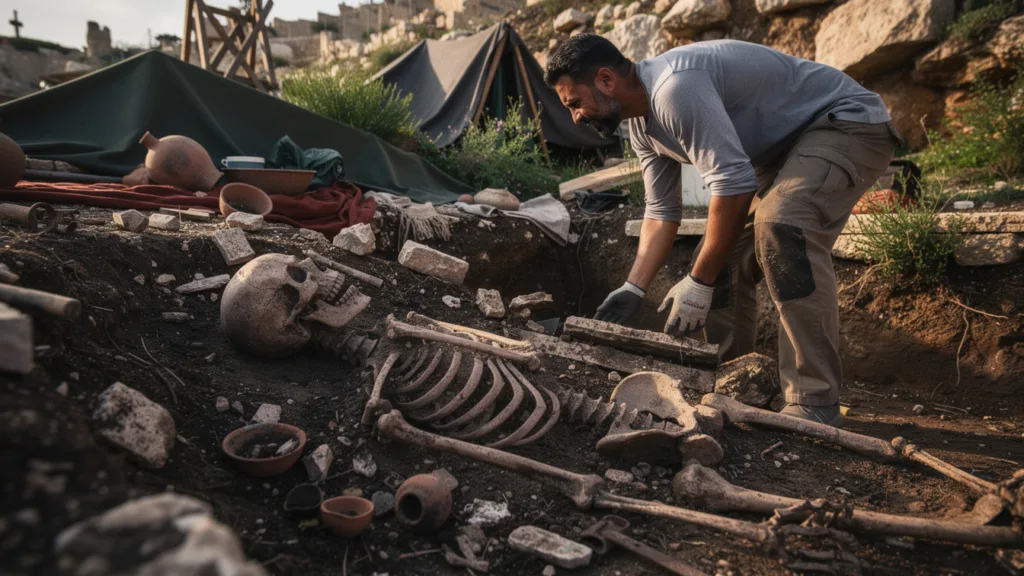

In a world captivated by mystery and the echoes of ancient cultures, few discoveries send shivers down the spine quite like the unveiling of a buried skeleton wrapped in chains. This unsettling yet profound find in Jerusalem, dating back to 1,500 years ago, challenges our preconceived notions about religious practices, gender roles, and the depths of devotion. The layers of history seem to peel away with every piece of evidence, offering a glimpse into a time where the lines between devotion and suffering were often blurred.
Highlights
- 🔍 Uncovering a woman’s skeleton in Jerusalem raises questions about gender roles in ancient religious practices.
- 🔗 The chained burial reflects a complex relationship between punishment, asceticism, and community perception.
- 🧪 Innovative proteomic analysis confirmed the skeleton as female, reshaping historical narratives.
- 📜 The discovery emphasizes the significance of female asceticism in Byzantine culture.
The initial excavation at the Byzantine monastic site of Khirbat el-Masani emerged in the dusty remnants of Jerusalem’s storied past, where archaeologists initially believed they had uncovered the remains of a male ascetic, a figure traditionally associated with extreme self-discipline. But as science would have it, perceptions shift like sand through an hourglass. Proteomic analysis revealed the skeleton belonged to a woman, forcing historians to reconsider long-held beliefs about the practices of female ascetics.
The Initial Findings: A Chained Grave Defying Expectations
When I learned about this remarkable find, my thoughts spiraled back to the initial excavation in 2017. Under layers of earth, researchers uncovered a body secluded within a stone grave, adorned not with jewels but with heavy iron chains. This burial rite was unlike anything typically marked in historical texts, which predominantly describe chained bodies as indicative of crime or social exclusion.
But in a region rife with monastic traditions, these chains may symbolize something deeper. They could represent a radical commitment to spiritual discipline rather than punishment. According to early Christian sources, monks often used chains as physical reminders of their rejection of worldly comforts. This particular burial challenged existing narratives and introduced a fascinating twist—a biological female ascetic practicing extreme forms of self-denial.
The Role of Women in Ancient Ascetic Practices
As the narrative unfolded, I began pondering the implications of this discovery. Early texts predominantly describe chained ascetics as men, weaving tales of radical hermits and holy men who shaped spiritual landscapes. Yet, the case at hand introduces evidence of women’s involvement in similar ascetic practices. This revelation compels us to reconsider their roles in religious spaces, especially in a patriarchal setting like Byzantine Jerusalem.
The chains that adorned her remained heavy with meaning. They could signify not just self-imposed suffering, but an intense spiritual struggle, resonating with the emotional weight of religious devotion. Beyond mere physical constraints, these chains painted a vivid picture of how women navigated their devout lives against societal norms and expectations.
- 👩🎓 Many women were known to leave their luxurious lives to pursue ascetic devotion.
- 📚 Historical accounts mention at least a few women who practiced chained asceticism, though these cases are often lost in narratives focused on men.
- 🏛️ There’s evidence of women contributing to the founding of convents and funding religious communities, challenging the patriarchal constructs of their time.
Scientific Revelations: The Beauty of Modern Archaeology
Amidst the dusty ruins, the wisdom of modern science began to reshape our understanding. Advances in proteomic analysis allowed researchers to delve deep into the skeleton’s enamel, revealing robust evidence of the individual’s sex—a breakthrough from conventional morphometric methods that often fell short. It was exhilarating to see science unravel the enigmas of history, repositioning figures into new narratives that cast light on the complexities of gender and spirituality in the past.
This skeleton exemplifies how contemporary archaeology can radically alter historical interpretations. Institutions like the Israel Antiquities Authority underscore the importance of utilizing innovative methodologies to unearth truths hidden in fragments. This single find is not just about a chain-bound woman; it speaks volumes about the spiritual dynamics of a bustling Byzantine Jerusalem.
The Broader Implications for Understanding Asceticism
This discovery echoes beyond the crypt of Khirbat el-Masani. It invites us to look at ascetic practices through a lens that encompasses both the voluntary and coercive aspects of religious life. The chains could symbolize deep devotion and societal imposition, merging the sacred and the punitive in complex ways.
As contemporary audiences wrestle with similar themes—whether through modern fasting practices or social constraints—it raises questions about the nature of personal sacrifice in faith. The Woman’s Skeleton reminds us that the boundaries of spirituality often intertwine with the struggles of identity and community expectations, a sentiment that continues to resonate in today’s world.
Each generation finds its own path to wrestle with the meanings of devotion and discipline, a narrative not lost on this female ascetic. Buried in chains beneath the soft earth of Jerusalem, her legacy invites us to step into the shadows of our own religious and personal struggles.
Reflecting on the Lessons of History
As we ponder the implications of this shocking discovery, we are reminded of the intricacies of cultural heritage—how the past shapes the present. The woman whose remains challenge our historical narratives is not merely a relic of ancient practice but a figure whose life embodies the tension between freedom and constraint. This complex interplay of ascetic devotion urges us to confront our perceptions of faith, gender, and the essence of community.
This singular skeleton is more than just a curious archaeological finding. It reveals a narrative tied to broader themes of identity, spirituality, and societal norms. As our understanding of ancient practices evolves, so too must our reflections on how history shapes our modern beliefs and behaviors. This discovery is a vivid tapestry in the enduring quilt of our shared past, reminding us that even in chains, the spirit remains unbound.